
Advice on naming an Indian D2C brand is easy to find and hard to check. Keep it short, the way Ola and Zepto are short. Use an Indian-language word, because vernacular names are said to be winning. Invent something, because an invented word is easier to own. None of it comes with a number attached.
So we counted. We took 1,500+ Indian D2C brands and sorted every name by what it is built from, what was done to that word, and what it points at. We also recorded the domain each brand ended up on, which turned out to be the most useful column in the set.
What the data says to do
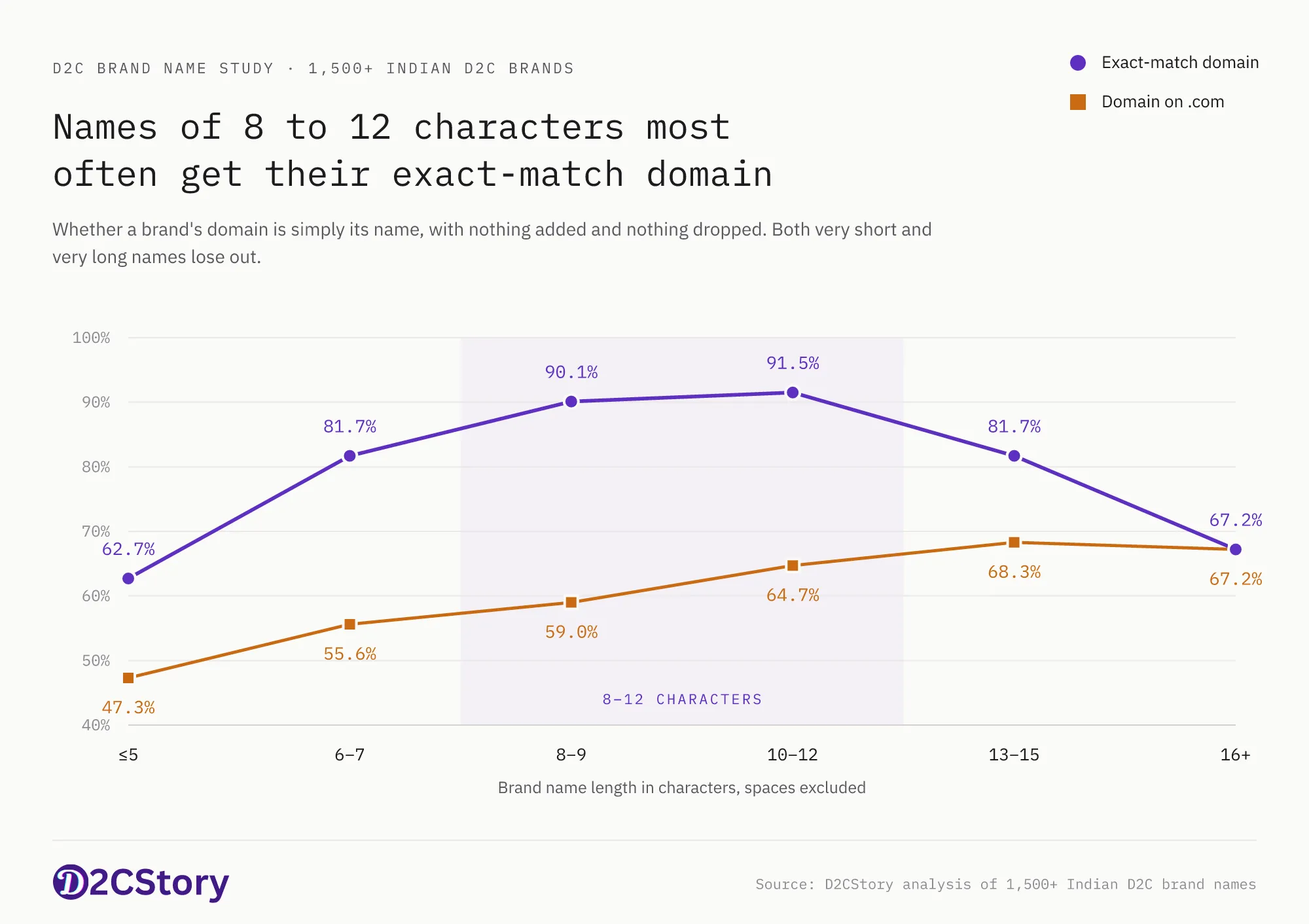
- Aim for eight to twelve characters. Names that length get a domain that is exactly their name 90.9% of the time. Under six characters, only 62.7% do.
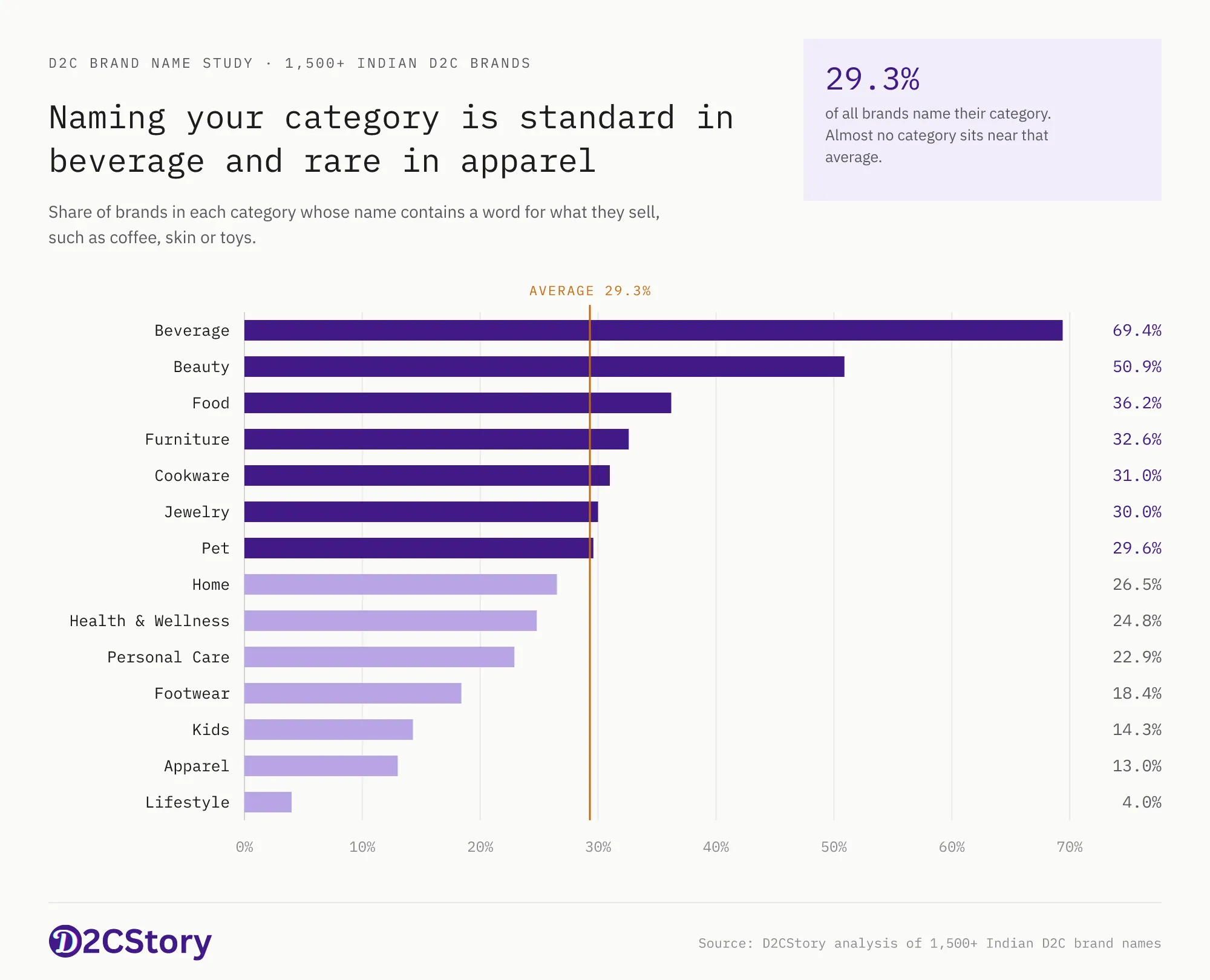
- Check your category before deciding whether to name the product. Seven in ten beverage brands put the drink in the name. In apparel, barely one in eight does.
- If you want the .com, a Sanskrit or Hindi word is the easier route. 73.1% of Indian-language names have one, against 53.1% of English names.
- Search your root across the whole category first. Fifteen brands here are built on the word veda, and thirteen of them sell the same kind of product.
What 1,500+ Indian D2C brand names are made of
| What the name is built from | Brands | Share |
|---|---|---|
| An English word | 1,222 | 78.7% |
| An Indian-language word | 260 | 16.7% |
| Something invented | 168 | 10.8% |
| A non-Indian foreign word | 132 | 8.5% |
| A place | 86 | 5.5% |
| A person | 60 | 3.9% |
| Initials | 38 | 2.4% |
Two other numbers stand out. Almost two thirds of these names, 64.1%, do not point at anything: not the product, not the buyer, not an idea. And only 54 brands, 3.5% of the set, are a plain English dictionary word used exactly as it is, with nothing changed and nothing added.
Those 54 are worth looking at on their own, because they show what a common word costs you.
Not one of them owns the matching .com. Noise sells on gonoise.com. Sleepyhead sells on mysleepyhead.com. Comet sells on wearcomet.com. Only 24 of the 54 got a domain that is just their name and nothing else, and 20 of those are on .in or .co.in: Bummer on bummer.in, Enamor on enamor.co.in, uppercase on uppercase.co.in. The last four went to stranger endings: .co, .shop, .life and .xyz.
Put simply: pick a word everyone already knows and you will probably end up adding something to it. Across the whole set, 83.3% of brands got a domain that is exactly their name. Among these 54, it is 44.4%.
Most brands avoid that problem by doing something to the word: joining two together (23.4%), changing the spelling (8.2%), or adding an ending (6.1%). Just under half the set, 47.4%, is a single word.
How long should a brand name be?
The usual advice points at the big consumer tech names. Four or five letters, two syllables, done. For a D2C brand that advice has a price, and it shows up in the address bar.
| Name length | Brands | Got the exact-match domain | On .com |
|---|---|---|---|
| 5 characters or fewer | 150 | 62.7% | 47.3% |
| 6 to 7 | 279 | 81.7% | 55.6% |
| 8 to 9 | 344 | 90.1% | 59.0% |
| 10 to 12 | 425 | 91.5% | 64.7% |
| 13 to 15 | 230 | 81.7% | 68.3% |
| 16 or more | 125 | 67.2% | 67.2% |
Names of eight to twelve characters get their exact name 90.9% of the time. The shortest names are 28 points worse than that, the longest are 24 points worse, and both ends are a bad place to be for opposite reasons.
Short names run out because five-letter words are the most fought-over addresses on the internet, and you are competing for them with everyone. Long names run out at the other end: by sixteen characters the domain has usually been cut down to something shorter, so the name on the pack and the name people type stop matching. The middle of this set is ten characters, which is about where the peak sits.
Three things have moved together over the last decade.
| Founded | Brands | Single-word names | Got the exact-match domain | Changed a word’s spelling |
|---|---|---|---|---|
| 2009 and earlier | 102 | 42.2% | 87.3% | 2.0% |
| 2010 to 2012 | 55 | 47.3% | 92.7% | 5.5% |
| 2013 to 2015 | 111 | 47.7% | 82.9% | 8.1% |
| 2016 to 2018 | 247 | 50.2% | 82.2% | 10.1% |
| 2019 to 2021 | 286 | 49.3% | 81.1% | 7.7% |
| 2022 onward | 135 | 58.5% | 78.5% | 11.1% |
Names got shorter, domains got harder to find, and spelling started to bend. Slurrp Farm, Boult Audio, Avvatar, Ellementry, Awsum and Flo Mattress are all the same move: take a word that is gone, change one letter, take the domain.
Should your brand name say what you sell?
Across the whole set, 29.3% of names contain a category word. That average hides a huge range, from 4.0% to 69.4%.
| Category | Brands | Uses a category word | The words they use |
|---|---|---|---|
| Beverage | 85 | 69.4% | coffee, tea, water |
| Beauty | 53 | 50.9% | beauty, cosmetics, nails |
| Food | 163 | 36.2% | foods, sweets, snacks |
| Furniture | 46 | 32.6% | furniture, home, decor |
| Cookware | 29 | 31.0% | kitchen, cookware |
| Jewelry | 60 | 30.0% | jewels, jewellery, diamonds |
| Pet | 27 | 29.6% | pet |
| Home | 132 | 26.5% | home, decor, living |
| Health & Wellness | 121 | 24.8% | nutrition, sports |
| Personal Care | 140 | 22.9% | skin, care, wellness |
| Footwear | 38 | 18.4% | sports, footwear |
| Kids | 112 | 14.3% | toys, baby, care |
| Apparel | 200 | 13.0% | fashion, clothing, socks |
| Lifestyle | 25 | 4.0% | none |
In beverage, naming the drink is almost the rule. Seven in ten do it, and Rage Coffee is the standard shape of a name in that aisle. In apparel it is the exception. In lifestyle it hardly happens at all. So this is mostly not a matter of taste. Which category you are in has already decided it, and a founder arguing about it alone is arguing about a question their sector settled long ago.
Beverage does pay for it. It has the worst domain record of any category, 68.2% against 83.3% across the set, because coffee, tea and water were taken as domain words decades ago. That has not stopped brands using those words, and what they do instead is covered in what to do when the .com is taken.
One habit is fading slowly. Brands founded before 2010 used a category word 34.3% of the time; brands founded from 2022, 20.0%. The year-by-year numbers wobble rather than fall in a straight line, so treat that as a drift and nothing firmer.
Should you use a Sanskrit or Hindi name?
| Name built from | Brands | On .com | On .in or .co.in | Got the exact-match domain |
|---|---|---|---|---|
| An Indian-language word | 260 | 73.1% | 22.3% | 86.5% |
| Something invented | 168 | 68.5% | 28.0% | 78.6% |
| English only | 826 | 53.1% | 42.1% | 83.9% |
The first column is the real gap, and it is twenty points wide. A Sanskrit or Hindi word is only competing for a domain with other Indian brands. An English word is competing with the whole world.
Those .com figures are also the good kind of advantage. Looking up when each of those domains was first registered shows that Indian-language names mostly got a fresh .com rather than buying one off somebody else, 83.7% against 77.3% for English names. The catch is that the advantage disappears below six characters, which we cover in .com or .in for an Indian D2C brand.
The last column is the one people skip, and it changes the advice. 86.5% against 83.9% is effectively the same number. An English word does not cost you your own name. It costs you the .com. Bewakoof, Chumbak, Setu, Traya, Ustraa, Libas, Soch and Ugaoo are all on exactly the domain you would guess.
Two things about those 260 Indian-language names are worth knowing before you reach for a dictionary.
The first is that “Indian language” really means two languages. Sanskrit accounts for 116 of them and Hindi for 108. Everything else barely registers: Urdu 14, Tamil 9, Telugu 5, Marathi 4, Kannada 2, Bengali 2, Gujarati 2, Punjabi 2, and no Malayalam at all.
The second is that the much-discussed shift to Indian-language naming has not actually happened.
| Founded | Brands | Built on an Indian-language word |
|---|---|---|
| 2009 and earlier | 102 | 17.6% |
| 2010 to 2012 | 55 | 12.7% |
| 2013 to 2015 | 111 | 15.3% |
| 2016 to 2018 | 247 | 21.5% |
| 2019 to 2021 | 286 | 17.5% |
| 2022 onward | 135 | 15.6% |
It rose a little in the late 2010s and came back down. Brands founded in the last few years use Indian-language words at about the rate brands founded before 2010 did.
Is your brand name root already crowded?
There are two different things people mean by a crowded name, and only one of them is a real problem.
The first is a shared category word. It is very common and mostly harmless. Twenty-one brands in this set have “coffee” in the name, seventeen have “nutrition” or “nutri”, fifteen have “foods”. But the category word is not the part doing the work. Rage Coffee, SLAY Coffee, Sweet Karam Coffee and 1952 Coffee are each on their own exact domain, because rage, slay, sweet karam and 1952 are what separate them. The shared word sits at the end like a label on a shelf.
The second is a shared root buried inside a made-up word. That one bites. Fifteen brands here are built on veda. Thirteen sell health, wellness or personal care. Nine were founded between 2019 and 2023, which means most were being named at the same time, by people who each thought the idea was theirs: Gynoveda, Cureveda, Smartveda, Goodveda, Tribalveda, Girlyveda, Ayouthveda, The Ayurveda Co., Life Aveda, Butterfly Ayurveda and VedapureNaturals.
Read that list quickly and the names blur into each other. That is the difference. When the shared piece is welded into the middle of a coined word, the whole name starts to look like its neighbours, and a customer who half-remembers you can land on any of the other ten.
Other roots carry a similar load. “Skin” appears in 18 names, “house” in 18, “organic” in 17, “beauty” in 17, “natur” in 16, “baby” in 13. A hundred names begin with “The”. Twenty-five genuinely carry India or Indian.
Even the first letter is crowded. T starts 12.0% of these names, S 9.2%, M 6.8%, A 6.8% and B 6.6%. Five letters open 41.4% of every brand in the set, which begins to matter the moment your name sits in a list beside its competitors. It matters again when you try to register it, which is covered in trademark clearance below.
What do you do when the .com is taken?
260 brands, 16.7% of the set, never got a domain that is just their name. Four in five of them kept the name and rearranged the domain around it. Only 23 gave the name up.
-
A small prefix or suffix: 79 brands. go, the, my, shop and let’s on the front, or india, store and world on the end. Noise trades on gonoise.com, Cello on celloworld.com, Mulmul on shopmulmul.com. This is the move founders reach for first, and the one that looks cheapest.
-
A category word added or dropped: 68 brands. It runs both ways. Iba added one and trades on ibacosmetics.com. Thirty-three brands went the other way: Rebaari Jewels on rebaari.com, Levista Coffee on levista.in, Amama Jewellery on amama.in.
-
A describing word added or dropped: 63 brands. Not what they sell but how they present themselves: studio, collective, handmade, design. Ekatra trades on ekatrahandmade.com; Escaro Royale went the other way, to escaro.in.
-
Spelt differently on the domain: 27 brands. A numeral written out, an accent dropped, two words run together. Supply6 on supplysix.com, ANA Apparels on anapparels.com.
-
A different name on the domain: 23 brands. The only group that gave up the name. Wow Skin Science sells on buywow.in.
Dropping is the trade founders tend not to consider, and it is the cheaper one. Your domain does not have to carry your whole name, only the part people will type.
There is a fourth move that none of these brands’ stories show on the surface, because it does not change the name at all: take a different general-purpose ending. Minimalist sells on beminimalist.co, Nu Republic on nurepublic.co and Kosha Yoga Co on koshayoga.co. .co is open to anyone, it is not India-specific, and it is where short names tend to land once the .com is gone. We looked at which endings Indian D2C brands actually use in a separate study.
There is one more option, and it is not really a workaround at all. A small group of brands have used the ending itself as part of the name: Tulum Coffee on tulum.coffee, The Cinnamon Kitchen on cinnamon.kitchen, Jaipur Watch Company on jaipur.watch, TeaFit on tea.fit, Traya on traya.health, Anveshan on anveshan.farm, Corridor Seven Coffee on corridorseven.coffee. There are around a dozen of these across the set. Endings like .coffee, .kitchen, .watch and .farm are cheap and wide open, and still rare enough here that using one reads as a decision rather than a compromise.
One thing worth saying plainly, because it comes up in every naming conversation: .in is not a failure. Just under 35% of these brands are on .in or .co.in, and they get their exact name more often than the .com brands do, 89.3% against 79.8%. You give up the ending. You usually keep the name.
Should you invent a word?
168 brands, 10.8%, are built on something invented. About 6.6% are pure coinages with no source word underneath at all.
There is a house style, and it is more consistent than you would expect. Among single-word names, 60.0% of the invented ones end in a vowel, against 30.2% of the English ones. Across all one-word names, 15.5% end in “a” and 7.3% end in “o”. Clovia, Iba, Veeba, Melorra, Taneira, nyumi and Shumee are all the same shape: a cluster of consonants, then a soft vowel to land on.
Invented names do well on .com, 68.5% of them, comfortably ahead of English words. But they have the worst record in the set for getting the exact name, 78.6%. A word you made up is often already made up.
You can see how tight the space is inside this set alone. Six pairs of brand names here are a single letter apart, and three of those pairs sell into the same category: two apparel brands separated by one consonant, sitting on the two matching .in domains; two kids brands; two home brands whose domains differ by one vowel. Each of those names was invented in a room where it sounded like nobody else’s.
Two naming habits that faded
Naming a brand after its founder has largely stopped. It was on 9.8% of brands founded before 2010 and 3.0% of those founded from 2022. Dr Sheth’s, Dr Vaidya’s, Chandrani Pearls and Cothas Coffee Co. are the older pattern, still trading.
Putting the city or region in the name went the same way, 9.8% down to 2.2%. Bombay is the one place name that held on: Bombay Shaving Company, Bombay Sweet Shop and Bombay Trooper all use it for what it suggests, not to tell you where the warehouse is.
Why both faded is a guess rather than a finding, but the likely reason is simple. A surname and a city each make a brand smaller, at exactly the point where a D2C brand wants to look national and wants room to sell other things later.
Trademark clearance is a different job from this
Everything above is about what is available. None of it is about what you can own, and the two come apart all the time.
A free domain tells you nothing about whether a name can be registered. In India a trademark is granted for a class of goods and services, not for a word outright, and the public database at ipindia.gov.in is where you check. Search your name there, along with its close sound-alikes, in the class your products fall under, and do it before you get attached to anything. A name approved by the Ministry of Corporate Affairs for company registration is a different process and clears nothing on the trademark side. Founders mix those two up constantly, usually after the logo has been drawn.
This is where the crowding above starts to matter for real. If fifteen brands in one category are built on veda, if forty-one names contain India, if a hundred start with “The”, then a name made of those pieces is not distinctive in the way the registry uses that word. It is one of a crowd, being examined against a register that already holds the crowd. The roots that come to mind easiest are the ones most likely to come back with an objection.
We have no trademark data, so this article is no substitute for a search. A free domain does not mean a free name.
A naming checklist from the data
- Aim for eight to twelve characters. That range gets the exact-match domain 90.9% of the time. Under six characters you are competing with the whole internet.
- Let your category decide the category word. 69.4% in beverage, 13.0% in apparel. Look at your own aisle before deciding this on instinct.
- If the .com matters to you, a Sanskrit or Hindi word or an invented one is the shorter path. 73.1% and 68.5%, against 53.1% for English.
- Check .in before you decide you failed. A third of this market is there, mostly on its own exact name.
- Search your root across your whole category, not just your shortlist. Especially if the root is buried inside the word rather than sitting at the end of it.
- Decide which workaround you can live with before you fall for a name, because one brand in six needs one. Shortening is the most common and the least awkward.
- Run the trademark search before the logo, not after. ipindia.gov.in, in your class, including the misspellings.
What this data cannot tell you
Every brand here is one that is currently trading, which makes this a survivors’ list. A name that sank a brand in its first year never made it into the set, so nothing above is a pattern that protects you.
There is also no revenue or survival data here. We know what these brands are called and what domains they ended up on. We do not know what any of that did to their sales, and anyone who tells you a naming pattern causes growth is guessing. The domain findings are the closest thing to a real consequence in this study, and even those are about cost and availability, not performance.
This is the first half of a two-part study. The second half takes the same 1,500+ brands and looks at the domain rather than the name: should your Indian D2C brand use .com or .in, which ending brands actually pick, and whether anyone really moves from one to the other later.
You can check any name on this page, and your own shortlist, against the Indian D2C brands database.